Showing posts with label hayao miyazaki. Show all posts

Thursday, March 22, 2012

100 Movies - No. 83: Spirited Away

83. Spirited Away (2001)
Animation, Adventure, Family, 125 minutes
Directed by Hayao Miyazaki
Starring the voices of Daveigh Chase, Jason Marsden, Suzanne Pleshette and David Ogden Stiers (US dub)

My Neighbor Totoro is my favorite Hayao Miyazaki film most days, but Spirited Away is on the same level. It's the best animated film ever to win an Oscar.

So what elevates it from other great animation such as Pixar? It's a combination of many things.

Miyazaki's animation feels different to anything else that I've experienced. It's detailed and complex, with well-developed characters, and it has heart. He creates lovable characters, but some have human flaws and they are more real than characters found in most animated fare.


Spirited Away tells the story of a 10-year-old girl named Chihiro (Chase). Her parents are driving her to their new home and she's upset about leaving her friends behind. In fact, she's bratty and whines a lot. Her father drives down the wrong road and they end up in an abandoned amusement park. Although it's deserted, they can smell food. Chihiro's parents decide to take advantage of a free meal, but Chihiro doesn't. She's horrified to see them transform into pigs.

While she is deciding what to do, a boy named Haku (Marsden) shows up and urges her to leave before it gets dark. She refuses to leave her parents so he decides to help her. Darkness brings a few changes and spirits appear. An area which appeared to be deserted is suddenly alive with light and chatter. Haku explains to Chihiro that she will never be allowed to leave unless she earns her place in the town. To do so, she must seek employment at the bath house.


The bath house is run by Yubaba (Pleshette) and she's a formidable witch. But, with the help of Kamaji (Stiers), who takes care of the boiler, Chihiro is given a chance to find a job. She's assigned to Lin, who shows her what to do. Lin also tries to toughen Chihiro up and teach her to improve her sullen attitude and learn some manners. Spirited Away is a coming-of-age story in which Chihiro eventually becomes a happy, confident girl, capable of facing anything.

The story is vast and quite complex for an animated film. Miyazaki doesn't rush things and takes a little over two hours to show Chihiro's story. It's aimed at an older audience than films such as Ponyo and My Neighbor Totoro, but it contains some of the beauty and innocence that's present in all Studio Ghibli films.

Miyazaki's imagination is almost limitless. You'll meet witches, soot sprites, dragons, spirits, weird animals and a giant baby. I've sometimes heard people complain that they don't understand the story. If you just accept it as a fantasy where magic exists, it's really pretty easy to follow.


The style of animation may be different from anything that you are used to. The image is two-dimensional and each frame looks like a watercolor painting. But take note of the amount of detail present in each frame. Some of it doesn't need to be there for the story to work, but it's a richer experience because it is present. When Chihiro nervously edges down a steep flight of stairs, look at the detail in the individual steps. When she puts her shoes on, there's a very human gesture that most animators wouldn't bother with. Spirited Away is clearly a labor of love and a work of art.

If you give the film a try, you might find yourself hooked after about two minutes as I was. The look of the film and Joe Hisaishi's score set a mood immediately and draw you in. It's a slightly darker and more dangerous world than many Studio Ghibli settings, but you'll be reluctant to leave.

If you like Spirited Away:

I would confidently recommend all of Hayao Miyazaki's films, but Spirited Away is aimed at an older audience than some. I would suggest Princess Mononoke, Nausicaa of the Valley of the Wind, Castle in the Sky and Kiki's Delivery Service for fans of Spirited Away. If you like those, why not check out all of Studio Ghibli's offerings? The weakest films are still better than all but the very best animated titles.

Return to index of 100 movies to see before you die.

Return to index of every review on the site.

Monday, July 18, 2011

Nausicaä of the Valley of the Wind: Miyazaki's first masterpiece

Nausicaä of the Valley of the Wind (Animation, Action, Adventure)
Directed by Hayao Miyazaki
Starring Alison Lohman, Patrick Stewart, Uma Thurman and Shia LaBeouf

Disney / Buena Vista | 1984 | 118 min | Rated PG | Released Mar 08, 2011

Video:
Video codec: MPEG-4 AVC
Video resolution: 1080p
Aspect ratio: 1.85:1

Audio:
English, French, Japanese: DTS-HD Master Audio 2.0

Subtitles:
English, English SDH, French

Discs:
50GB Blu-ray Disc
DVD copy

The Film 5/5

When it comes to animation, my favorite director by far is Hayao Miyazaki. If you have read my Top 20 animated list, you’ll see how often his name appears. Studio Ghibli has been responsible for many good films, but Nausicaä of the Valley of the Wind was actually released in 1984, just before the studio was founded. It remains Miyazaki’s most ambitious work because of its epic scope.

Nausicaä is set approximately a thousand years in the future when pollution levels have threatened to destroy life on the planet. The land is dominated by the Toxic Jungle which is filled with poisonous plants. The jungle is protected by giant insects and other creatures.


We meet Nausicaä (Lohman) early in the film when she discovers a discarded ohm shell. Ohms are giant creatures which seems wiser than any humans they may encounter. Nausicaä recovers one of the parts of the shell and takes it home. Ohms are not always calm and their eyes grow red with rage when they are angry. Nausicaä helps save Lord Yupa (Stewart), a master swordsman, from an enraged ohm.

Yupa knows Nausicaä well and has a present for her; a small fox squirrel which she names Teto. Her first encounter with the creature shows us her true nature. She says that there is nothing to fear, but the fox-squirrel bites her. She makes no move, but simply repeats that there is nothing to fear. It stops biting and licks the wound. It’s such a touching scene and gives a hint at how Nausicaä interacts with strangers later in the story. She’s an easy character to love.


Nausicaä’s life is peaceful. She lives in the Valley of the Winds where everyone works together in harmony farming the land. Although her father is the king, princess Nausicaä doesn’t put herself above other people. She lends a hand repairing machinery or whatever else is needed. Her people love her; especially the children. For any parent thinking of showing the film to their children, Nausicaä is a good role model.

The film has quite a few battle sequences, but they are brief and involve misguided people who think their causes are just. I think Miyazaki is showing us what could happen if we continue to pollute and exploit the planet without giving any thought to the future. It’s a common theme in his stories and is more prominent here than in later films. 


Unlike any other animated film I have seen, Nausicaä of the Valley of the Wind shows us a vast world. We explore some of it and see Nausicaä discover secrets about the world and the creatures inhabiting it. She has a way with animals and insects and seeks solutions that avoid killing any kind of creature. She seems to empathize and realize how to stop seemingly wild creatures from attacking. People around her are frequently amazed by her actions.

The film shows the futility of war and the power people have to change their lives by thinking about their course of action. So much happens in the two hour running time that the film seems to move at a breakneck pace. There is always something happening, whether it’s action or a discovery of some kind.


Joe Hisaishi is again responsible for the music, and it’s one of the best scores he has ever produced. There’s a particular scene with a piece of music using children’s voices which has me in tears every time. I’m not sure why, but the music is powerful and fits the scenes perfectly.

I know I haven’t revealed much of the story. That’s because I want you to discover the secrets for yourself. Nausicaä of the Valley of the Wind reminds me of scenes in Avatar and Star Wars, but the story is arguably more powerful than both. If you have seen other titles from Hayao Miyazaki, be aware that this contains more adult themes than most. That said, it can and should be enjoyed by the whole family.

Video Quality 4.5/5
If you have seen any of Miyazaki’s films, you’ll know that his animation style looks nothing like modern studios such as Pixar or Dreamworks. He’s an artist in the true sense of the word and the frames of the films look like watercolor paintings. It’s been 27 years since the film was released, so the animation style looks a little dated. Some of the supporting characters in crowds won’t move, but the overall effect is still wonderful. Disney has delivered another great transfer. Colors improve dramatically over the DVD version. Some scenes look slightly soft, but that’s partly due to the animation style. This doesn’t look like Up, Ratatouille or Rango, but detail is strong and any Miyazaki fan will be delighted with the result.

Audio Quality 4/5
The film comes with three audio mixes. Disney failed to provide a lossless Japanese option for Ponyo, but purists will be happy to see the Japanese: DTS-HD Master Audio 2.0 track included this time. Other versions include English and French: DTS-HD Master Audio 2.0. Although a 5.1 mix would have been welcome, I’m not disappointed by the options on offer. Dialogue is clear throughout, while battle scenes pack a considerable punch. Ambient sounds such as wind in the valley come across well, as does Joe Hisaishi’s score.

Special Features 3/5

The additional features are split between the BD and the DVD.

As with other Miyazaki films, Nausicaä of the Valley of the Wind includes the option to view the entire film with the original Japanese storyboards. It’s interesting to see how Miyazaki’s original sketches developed.

Enter the Lands of Ghibli gives the viewer the option to click on characters from some of the other films. There’s not a huge amount of content, but it’s nice to see.

Behind the Studio: Creating Nausicaä (12 minutes, HD) – A brief feature which includes thoughts from Miyazaki.

The Birth Story of Studio Ghibli (28 minutes, SD) – A TV documentary from Japan talking about Studio Ghibli’s origins.

Behind the Microphone (8 minutes, SD) – The American cast is shown recording some of the scenes and talking about the film.

Original Japanese Trailers and TV Spots (8 minutes, SD)

Nausicaä of the Valley of the Wind includes a lot of themes and elements that we have come to expect in a Hayao Miyazaki movie, but it’s more epic in scope. Like Avatar, this makes me feel like I am stepping onto another world. Unlike Avatar, the dialogue isn’t dumb in any way. I like Nausicaä as a character because her intentions are always good. She sees the best in everyone and is a positive force. The whole experience makes the film one I love to revisit and it’s always rated among my favorite animated titles. Disney’s Blu-ray presentation does the film justice and is highly recommended as a story that can be enjoyed by the whole family.

Overall score 4.5/5

Return to index of every review on the site. 

Thursday, June 23, 2011

My Top 20 animated movies: Part 4, #1-5

My Top 20 animated films (continued)

I would just like to mention that Grave of the Fireflies was included in my Top 20 dramas and has therefore been omitted from this list. It would have placed second.

Here are my Top 5 animated films:


5. Ratatouille (2007)
Directed by Brad Bird and Jan Pinkava
Starring the voices of Patton Oswalt, Lou Romano, Ian Holm and Janeane Garofalo

If you have read my other three articles in this series, you’ll know I love Pixar. The Incredibles, Finding Nemo, Cars, Wall-E and the Toy Story trilogy narrowly missed making my Top 20, but all are worth owning. Ratatouille is my favorite entry from the studio and I would love to see a sequel one day. Remy (Oswalt) is a rat, gifted with an enhanced sense of taste and smell. He can tell the other rats what’s safe to eat, but aspires to be something more. After seeing a cooking show on TV, he discovers that he would like to cook. He seems naturally gifted and teams up with Linguini (Romano), who works as a kitchen boy in a Parisian restaurant. Linguini has no talent as a chef, but Remy finds that he can control him by tugging strands of hair while hiding under his toque. His food is popular with the customers, but he has to find a way to realize his ambitions. His journey is a lot of fun. Remy communicates almost entirely through body language when he’s with humans and his little gestures convey a lot of feeling. He’s such a happy little guy that it’s difficult to dislike him.

At 111-minutes, Ratatouille might not hold the attention of young children, but there’s no questionable content. It’s informative and charming, but lacks the constant action associated with most animation. The Blu-ray presentation is among the best you’ll find.

Click here for my full review.


4. Ponyo (2008)
Directed by Hayao Miyazaki
Starring the voices of Noah Lindsey Cyrus, Frankie Jonas, Liam Neeson and Tina Fey

My love for Miyazaki’s films started three years ago when I bought Ponyo on Blu-ray. After seeing his charming view of the world, I sought out every other title I could find from Studio Ghibli. Ponyo (Cyrus) is a little fish with the face of a girl and she escapes her underwater home and encounters Sosuke (Jonas). He rescues her when she becomes trapped in a discarded bottle and takes her home in a bucket. After licking blood from a cut on his finger, she starts to take on human form and the two become friends. Sosuke’s mother, Lisa (Fey), accepts the situation and knows that Ponyo is magical. Ponyo’s father (Neeson) looks for her because her presence in the human world is causing nature to be out of balance. The story is delightful and I love watching the two children grow closer. Ponyo loves ham and is capable of performing magic, while Sosuke accepts her for exactly what she is. Like other Miyazaki films, it’s a good place to visit. People respect each other and there are no villains. The weather and the balance of nature are the two biggest situations to overcome, and the whole story is a lot of fun. The animation is beautiful, especially during the opening scene in Ponyo’s home under the sea.

The Disney Blu-ray is an ideal way to experience this colorful world. Some might argue that Ponyo is aimed at young children, but I would say that the whole family should enjoy it. I don’t find it childish at all.


3. Spirited Away (2001)
Directed by Hayao Miyazaki
Starring the voices of Daveigh Chase, Jason Marsden, Suzanne Pleshette and David Ogden Stiers

Spirited Away won an Oscar for Best Animated Feature. The story starts simply enough when Chihiro (Chase), a 10-year-old girl, discovers an old amusement park with her parents. Although deserted, the stalls contain hot food. When the parents start to eat, they turn into pigs. She encounters Haku (Marsden), a boy who lives in the town, and he explains that she can only stay if she finds work. Chihiro begins the story as a whiny brat who complains about everything, but learning to work and taking responsibility for saving her parents changes her. She begins a long quest and we encounter all kinds of strange beings along the way. It’s probably the most complex of Miyazaki’s worlds and needs the full 124-minute running time to show us everything in sufficient detail. Chihiro helps Haku discover his true identity along the way and meets an interesting multi-limbed character named Kamaji (Stiers), who runs a boiler room and is happy to help her.

Some of the scenes are a little scarier than those in films such as Ponyo or My Neighbor Totoro, but it's still suitable for the whole family. There’s no Blu-ray release as yet, so you’ll have to pick up the DVD or wait a while if you want to own it.


2. Nausicaä of the Valley of the Wind (1984)
Directed by Hayao Miyazaki
Starring the voices of Alison Lohman, Shia LaBeouf, Patrick Stewart and Uma Thurman

The film was originally released in the US as Warriors of the Wind, but the extensive cuts lost the essence of the story and ruined it. The post-apocalyptic setting is epic in scope. Humans have polluted the Earth to such a degree that all that’s left are deserts, and jungles filled with poisonous plants. The people have to wear breathing masks to avoid the toxic air. Princess Nausicaä is a teenage girl with a good heart. She’s in tune with nature and the creatures inhabiting her strange world, and appreciates her surroundings. Her first instinct is to trust people and she believes that there’s good to be found in everyone. This vast journey shows us an unusual world filled with threats both real and perceived. Nausicaä has a few secrets and hopes to transform her damaged world. The ignorance of some of the people she encounters threatens the safety of all humans and everything she’s trying to achieve.

This is one of Miyazaki’s most adult-orientated films, but I wouldn’t stop young children from seeing it. The Disney Blu-ray is a big improvement over the DVD and I would recommend it to anyone.


1. My Neighbor Totoro (1988)
Directed by Hayao Miyazaki
Starring the voices of Dakota Fanning, Elle Fanning, Tim Daly and Pat Carroll

To be honest, I’m not sure whether Totoro is Miyazaki’s best film. It’s like trying to decide which of your children you prefer over the others. All of his films make me smile and I’m always moved when I watch any of them. Miyazaki sees things that most of us take for granted and manages to capture it in simple animation. The reason I have put Totoro above his other films (today at least) is the relationship between sisters Satsuki (Dakota Fanning) and Mei (Elle Fanning). Satsuki looks out for Mei, while Mei mimics her sister and obviously loves her. When the girls and their father move into a new house, I love seeing the determination on Mei’s face as she curiously explores her surroundings. For around 30 minutes, we focus on those charming scenes. Then, one day, Mei goes exploring on her own and meets a huge Totoro, who is a magical creature living in the nearby woods. He’s not threatening in any way so Mei goes to sleep on his belly. The two girls befriend the creature, who can only be seen if he wants to be seen. The world is a wonderful place, free of danger.

Young children will probably love My Neighbor Totoro, but adults should see something in it too. It’s beautiful and full of innocence, and shows us what it’s like to see the world through the eyes of a child. A Blu-ray release could come within a year or so, but it’s only available on DVD at present.

Click here for my full review.

If you have read the entire list, you’ll see that Hayao Miyazaki features prominently. Seven of the films he directed made my Top 20, and he wrote the screenplay for one of the others. If you haven’t checked out his films because they are Japanese, please consider giving one a try. All are dubbed into English and feature actors that you’ll be familiar with. I can’t promise you’ll love them as much as I do, but the potential reward is worth the time investment.

Did I include your favorites on my list? Thanks for reading and feel free to comment or post your own favorites.

Click here to see #16-20 on my list.

Click here to see #11-15 on my list.

Wednesday, June 22, 2011

My Top 20 animated movies: Part 3, #6-10

My Top 20 animated movies (continued)

You've seen the bottom 10 in my list of favorite animated movies. I love them all and it's difficult to place one above another, but the Top 10 do have something extra in my opinion.

Let's continue with the next five:


10. Monsters, Inc. (2001)
Directed by Pete Docter, David Silverman and Lee Unkrich
Starring the voices of Billy Crystal, John Goodman, Steve Buscemi and Mary Gibbs

Monsters, Inc. produces power for the city of Monstropolis by scaring kids and storing the energy produced in their screams. The two principals are Sulley (Goodman) and Mike (Crystal). Sulley is a giant furry beast with purple and blue fur and regularly tops the company standings as chief scarer. Mike is small, green and has one huge eye, and is Sulley’s assistant. They have doors with direct access to children’s bedrooms in the real world and get to work each night. Things are complicated by Randall Boggs (Buscemi), who is trying to cheat his way to the top of the standings. Direct physical contact with a human child is thought to be dangerous and possibly lethal, so a team stands by to sanitize any infected monsters. When Sulley inadvertently brings a little girl called Boo (Gibbs) to Monstropolis, he finds out the truth about human contact. With the help of Mike, Sulley tries to hide the little girl until they can get her home. The reason I love Monsters, Inc. so much is its heart. It’s a cute world and Boo is adorable. There’s a lot of clever humor throughout the movie and it lives up to Pixar’s high standards.

There’s nothing in the film that would scare children, so it’s a perfect family film. The Blu-ray presentation is strong in all areas. I could watch this film every few weeks and never get tired of it.


9. Wallace & Gromit: Curse of the Were-Rabbit (2005)
Directed by Steve Box and Nick Park
Starring the voices of Peter Sallis, Helena Bonham Carter and Ralph Fiennes

Here’s another claymation movie. It was good enough to win the Oscar for Best Animated Film, and it deserved the award. There were three short films in the series before this feature; all are funny and worth owning, but none match the quality of Were-Rabbit. For those new to the characters, Wallace (Sallis) is an inventor living in Northern England and Gromit is his faithful dog. The two run a service to protect people’s vegetables from the jaws of unwanted rabbits. They have a warning system similar to the one used in Thunderbirds and Wallace’s inventions are used to capture and store the rabbits. Gromit doesn’t speak, but says so much with his body language. He’s the source of most of the humor. There are jokes in almost every frame; both visual and verbal. The pair is hired by Lady Tottington (Bonham-Carter), who fears that her grounds are being overrun by rabbits. The expressions on the faces of the model rabbits are hilarious.

There’s no Blu-ray release as yet, but the first three shorts and a later fourth installment can be found on Wallace & Gromit: The Complete Collection Blu-ray. It isn’t actually complete because it’s missing this film, but it’s a must-own. Wallace & Gromit is funny, innocent and suitable for the whole family.


8. Bolt (2008)
Directed by Byron Howard and Chris Williams
Starring the voices of John Travolta, Miley Cyrus, Mark Walton and Susie Essman

Are you fan of Pixar titles? If I didn’t know better, I’d swear that Pixar created Bolt. It looks and feels similar and has so much heart. Bolt (Travolta) is a dog who stars in a TV show in which he has superpowers. That would make a good movie in its own right, but it gets even better. Bolt escapes from the film studio by accident and is separated from Penny (Cyrus), his owner. He listens to the advice of a group of pigeons and enlists the help of a cat named Mittens (Essman), who claims she knows how he can get home. They eventually run into a hamster, Rhino (Walton), who thinks that Bolt has real powers. They make their way across America in search of the film studio and Penny. Bolt keeps me laughing. It mixes slapstick humor with clever comments and astute observations. Watch how Mittens teaches Bolt to act like a real dog and you’ll see what I mean.

The movie is a good choice for the whole family and the Blu-ray presentation is flawless. The picture quality is perfect throughout and check out the sound during the sequences in which Bolt starts in the TV show.


7. Up (2009)
Directed by Pete Docter and Bob Peterson
Starring the voices of Edward Asner, Christopher Plummer, Jordan Nagai and Bob Peterson

Up is Pixar’s most adult-oriented release thus far, but it still contains enough fun and action to hold the attention of any child. There’s a silent montage near the start of the movie which tells the story of Ellie, who is the wife of balloon salesman Carl Fredricksen (Asner). The sequence takes us through their initial meeting as children and ends with Ellie’s death as an old woman. You’ll almost certainly cry or at least have to hold back tears. Carl and Ellie always planned to visit South America, but never got around to it. Carl decides to make the trip on his own by attaching balloons to his house so that it will fly. He finds Russell (Nagai) – a boy scout trapped on his porch – and the two make the trip together. They are joined by a weird bird and Dug (Peterson), who is a dog with the ability to talk using a device on his collar. The movie is very colorful and is full of action once the group is assembled. There are some other truly touching moments and I would urge anyone to see this film.

It’s suitable for people of all ages and has something for everybody. The humor is funny because it’s an accurate observation on the way people behave. Dug is the funniest character, but they all have their moments.


6. Kiki’s Delivery Service (1989)
Directed by Hayao Miyazaki
Starring the voices of Kirsten Dunst and Phil Hartman

Talking of heart, it’s time for some more Miyazaki. Kiki (Dunst) is a 13-year-old witch, and in her culture that means she has to spend a year on her own providing a service in another city. She’s just learning her craft and can barely fly her broom, but sets of with her cat, Jiji (Hartman). She finds a small town and helps the owner of a bakery by returning a baby’s pacifier to a customer who left it behind. The owner offers her a place to stay and suggests that she start a delivery service. It’s a delightful coming-of-age story in which Kiki learns to become independent and finds out about friendship and romance. She has great respect for her elders and quickly wins their approval. Jiji has almost all of the best lines and his sarcastic comments are genuinely funny. There are no villains, just situations and problems to overcome.

Kiki’s Delivery Service is charming and funny. It should entertain the whole family. There’s no Blu-ray release yet, but expect Disney to get around to it in a year or two. There are at least two DVD versions and the dubs are different. Be sure to research which one you want to own if you have previously seen the movie and have a preference.

For #16-20 on the list, click here

For #11-15 on the list, click here.

Tuesday, June 21, 2011

My Top 20 animated movies: Part 2, #11-15

My Top 20 animated movies (continued)

I promised yesterday that I would reveal the next five movies from my 20 favorite animated titles, so here they are:


15. Watership Down (1978)
Directed by Martin Rosen
Starring the voices of John Hurt, Richard Briers and Ralph Richardson

The first thing you should know is that I love rabbits. That made me curious about Watership Down, so I borrowed the DVD from my local library. Richard Adams’ novel tells the story of a small group of rabbits threatened by a development scheme which could destroy their home. Fiver (Briers), is a young rabbit with a gift; he catches glimpses of the future. He sees imminent danger and encourages the other rabbits to leave, but only a small group listen. Hazel (Hurt) is Fiver’s brother and leads the group as they search for a safer home. They are joined by Bigwig, Silver and Buckthorn. The group faces dangers from other animals, rival warrens and humans, and the quest continually encounters perilous situations. The film is informative for anyone interested in group dynamics as we see how the individuals find their roles in the new order. It also shows the difference between those with strong character and those who are too weak to do anything but follow the established rules. There’s a lot of blood as the rabbits fight for survival, and there is no shortage of death.

I wouldn’t recommend showing this to small children as it could give them nightmares for years to come. It’s suitable for older teens and up though. I’m anxiously awaiting the arrival of the German Blu-ray and I’ll write a full review after it arrives.


14. Tangled (2010)
Directed by Nathan Greno and Byron Howard
Starring the voices of Mandy Moore, Zachary Levi and Donna Murphy

Are you tired of seeing Disney films involving princesses and too many songs? I was, and that’s why I resisted the temptation to see Tangled. But after a while, I caved in and gave it a try. It was a pleasant surprise in more ways than one.

It’s the story of what happens when Rapunzel (Moore) and Flynn Rider (Levi) meet. Rapunzel is kept trapped in a tower by an old woman who taps her powers in order to remain young, while Rider is a thief. The two go on an adventure that’s full of discovery and action. You’ll also meet Pascal, a chameleon who has befriended Rapunzel. He doesn’t speak, but his body language is hilarious and he steals a few scenes. Maximus is the other source of humor. He’s a horse who spends his time tracking Rider in an attempt to bring him to justice.

Disney’s 50th animated title is a delight and suitable for people of all ages.

Here’s my full review.


13. Bambi (1942)
Directed by James Algar, Samuel Armstrong, David Hand, Graham Heid, Bill Roberts, Paul Satterfield and Norman Wright
Starring the voices of Hardie Albright, Peter Behn, Stan Alexander and Bobette Audrey

Bambi is a prime example of classic Disney. The main theme of the film is innocence, and it details the early years in the life of a young deer. I saw the film as a child and again recently when it was released on Blu-ray, and found that I had forgotten just how beautiful the story is. Bambi is raised by his mother and befriends various other forest animals such as Thumper the rabbit and Flower the skunk. We see Bambi learn how to walk and talk, always with the help of his friends. Like any youngster, he’s curious about his surroundings. The film is full of scenes in which he discovers new things and learns how to interact with his environment. The one scar on the film’s beauty is the death of Bambi’s mother. It happens offscreen, but it’s obviously something which could disturb small children. In fact, I know a few adults who won’t watch it because of that event. The remainder of the story is full of charm and we see how Bambi and his friends discover love and choose their mates.

The Blu-ray presentation is outstanding and the film looks great considering it’s almost 70 years old. Bambi gets my vote for the most beautiful story Disney has ever told.


12. Castle in the Sky (1986)
Directed by Hayao Miyazaki
Starring the voices of James Van Der Beek, Anna Paquin, Cloris Leachman and Mark Hamill

Sheeta (Paquin) is a young girl who falls from an airship at the start of the story. She wears a magic crystal which enables her to float safely to the ground. She meets Pazu who is a boy about her age and the two become friends. Friendship is a common theme in Miyazaki’s films and often forms the foundation of the story. The pair are being chased by pirates who want the crystal for themselves. Sheeta learns that knowledge of the crystals was once common and that an entire island was created which floated in the sky. The crystal is thought to have the power to show the location of the legendary island and so they try to establish its whereabouts. The story is full of action and adventure, as well as some surprises along the way. It works because of the sense of friendship between Sheeta and Pazu, and it has plenty of charm.

The film has been released on Blu-ray in Japan, Australia and the UK, so a North American release can’t be very far away. It's a good family film and can be enjoyed by people of any age.


11. Fantastic Mr. Fox (2009)
Directed by Wes Anderson
Starring the voices of George Clooney, Meryl Streep and Bill Murray

Wes Anderson’s adaptation of Roald Dahl’s story is often funny, but also contains serious themes which might be lost on some children. It uses stop motion and tells the tale of Mr. Fox, who has trouble resisting the temptation to steal from the local farmers. He’s not a very good father and can’t be trusted by his wife, but has a certain roguish charm. The film mixes standard animated action with a quirky sense of humor that’s more subtle than that found in most stories. His antics put his family and other animals in danger as the three farmers he robs team up and decide to kill him. The humor is close in style to that used in Bottle Rocket and The Darjeeling Limited, rather than something you would expect to find in an animated film. The story isn’t afraid to show animals being hurt or even dying, so caution should be used if you’re planning to watch it with smaller children.

The Blu-ray presentation looks incredible and the voice acting is strong throughout. There’s no other animated film quite like this one.

Here’s my full review.

For #16-20 on the list, click here

For #6-10 on the list, click here.

For #1-5 on the list, click here.

Return to index of every review on the site.

Monday, June 20, 2011

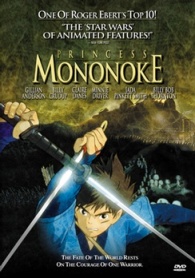
Princess Mononoke: Raised by wolves, but ultimately human

Princess Mononoke (animation, adventure, fantasy)
Directed by Hayao Miyazaki
Starring the voices of Billy Crudup, Gillian Anderson, Clare Danes and Minnie Driver

Miramax | 1999 | 133 min | Rated PG-13 | Released Dec 19, 2000

The Film 4.5/5

Here’s another film from Studio Ghibli that hasn’t yet seen a Blu-ray release. If you read my recent review of My Neighbor Totoro, you’ll know that I love Miyazaki’s animation, themes and characterization. This film has a different feel to Totoro and is aimed at older audiences.

The story lasts 133 minutes and is quite violent in places. The opening scene shows a boar possessed by a demon, which is an immediate threat to a village. Ashitaka (Crudup) tackles the beast and ultimately kills it, but injures his right arm in the process. The arm is essentially possessed and the infection is expected to spread throughout his body, killing him. He’s a danger to his own people and reluctantly has to leave in search of a cure.

Like most of Miyazaki’s characters, Ashitaka is a good person. One clue to his character is the way he treats Yakul, the red elk that he rides. The two seem like partners and it’s clear that he loves the animal.


Further clues to Ashitaka’s character can be seen when he saves another village from attack and rescues two drowning men from a river. We see that his infected arm seems to have additional strength and that enemies hit by his arrows can be decapitated. As I mentioned at the outset, the film is aimed at older audiences than those targeted by Totoro. It’s bloody and violent in places and death is always a possibility.

The first magical scene takes place in a forest. The locals fear it and the tree spirits that live there, but Ashitaka has no such fears. He sees the tree spirits as happy and childlike and willingly follows their directions. They lead him and the injured men to safety. He also catches a glimpse of the Forest Spirit, which is an altogether more powerful entity and has a big role to play in the story.

Ashitaka returns the men to their town and is thanked by the town’s ruler, Lady Eboshi (Driver). She’s one of the most interesting characters in the story. She’s capable of giving people a chance where others wouldn’t and has taken in prostitutes and lepers and given them honorable roles in her town. But she’s also fiercely ambitious and thinks she’s powerful enough to kill gods to gain more wealth and power. She’s a truly divided woman, but not definitely good or evil. She does seem to genuinely want to help the people under her care and protection. Her character changes significantly by the end of the story.


Princess Mononoke has been raised by a wolf-god (Anderson) and regularly rides one of its two cubs. She hates humans because she only ever sees them harming the forest. Her character is wild and reckless and will attack the town in an attempt to stop the people causing further damage to her beloved forest. She feels that if she kills Lady Eboshi, the threat will cease to exist.

Miyazaki’s animation doesn’t look modern. It has the look of a watercolor painting and is simply drawn; but with simple drawings, he’s capable of expressing a lot of emotion. When Ashitaka looks at his elk, the animal looks friendly, loving and intelligent. Its gaze and simple expression conveys all kinds of positive feelings. The forest is also a beautiful place and you’ll find that you want to see it protected and unharmed. The tree sprites project joy and innocence and that innocence is a common theme in Miyazaki’s work. I’m not sure how he does it, but it’s powerful and moving.

The final act is full of action and a number of key characters suffer major wounds. It’s not clear who will live and who will die, but not everyone survives. Some of the animals in the story are much more than dumb beasts and many are gods capable of mutual respect when they encounter souls who deserve it. There’s a sense of that respect throughout the film and the characters live by their own honor code.


Miyazaki places us right in the middle of the action and commonly uses a panning technique as if the frames were filmed instead of drawn. He also takes his time establishing scenes and it’s common to see water ripple, grass wave in the wind or clouds move across the sky. He seems to revel in the beauty of his worlds and I find that it helps me appreciate it all the more.

The conclusion of the story feels satisfying and right. It’s not a contrived ending at all, but one which could actually happen given the personalities of the characters and their situation. It’s interesting that Miyazaki’s villains usually consist of misguided people rather than truly evil individuals. This is often the case in real life and it works better than having a stock villain like those found in most animated movies.

The actors do a good job in the English version, but the Japanese dub is included with English subtitles for anyone wishing to experience the original version.

I have only seen Princess Mononoke three times and found it a bit muddled the first time. It improved with each viewing and I now consider it just below Miyazaki’s very best work. If you thought My Neighbor Totoro and Ponyo were too childish, give this a try.

Let’s hope that a Blu-ray release isn’t too far away.

Overall score 4.5/5

See where Princess Mononoke ranks among my Top 20 animated movies.

Return to index of every review on the site. 

My Top 20 animated movies: Part 1, #16-20

My Top 20 animated movies

Animated movies rarely get the respect they deserve. It’s common to hear people refer to them as cartoons and to regard them as lighthearted entertainment fit only for children. I suppose that idea comes from the fact that the majority of us enjoyed short cartoons when we were kids.

Classic Disney titles have been around for over 70 years and focus on material that is suitable for young children, but that doesn’t mean it’s not suitable for adults.

My Top 20 includes a number of Disney titles. Some have universal appeal while others are aimed at older audiences. Other films on the list contain messages that can appeal to people of any age. Some of the themes are complex and will only be understood by adults. I’ll mention which category each of my selections falls into.

It’s important to keep an open mind about animation and not label it as something too childish to bother with. You’ll miss out on some stunning stories if you do. There are currently 51 animated titles in my Blu-ray collection and the number would be much higher if other titles were available on the format.

Those of you who read my Top 20 Drama articles will know that Grave of the Fireflies is among my favorites. For that reason, I chose to omit it from this list.

That’s enough talk; let’s get started:


20. A Bug’s Life (1998)
Directed by John Lasseter and Andrew Stanton
Starring the voices of Kevin Spacey, Dave Foley and Julia Louis-Dreyfus

Pixar’s second movie focuses on a colony of ants. The story is about standing up to bullies and pursuing your own course even when you’re regarded as different or weird. That’s a good message for children. Flik (Foley) is a young ant with an imagination. He invents laborsaving devices to help his colony gather food for a group of aggressive grasshoppers, led by Hopper (Spacey). When an accident causes the gathered food to be lost, Flik is sent on a trip to enlist bugs willing to help the colony stand up to the grasshoppers. They are essentially getting rid of him and don’t expect him to succeed, but he returns with help. The new allies help the ants come up with a plan to defeat the grasshoppers. It’s a coming-of-age tale with lovable and quirky characters.

The animation looks great, especially on Blu-ray. Every blade of grass looks real and the detail is incredible. The story is a little scary in places, but is ultimately a lot of fun. It’s suitable for the whole family. 


19. How to Train Your Dragon (2010)
Directed by Dean DeBlois and Chris Sanders
Starring the voices of Jay Baruchel, Gerard Butler and Craig Ferguson

Here’s a movie that I expected to love, but it didn’t really grab me the first time I saw it. Maybe I was in the wrong mood that day because my opinion of it improved significantly on the second viewing.

The story is similar to the one in A Bug’s Life in some ways. It tells the story of Hiccup; a young Viking hoping to hunt dragons like most of the town’s inhabitants. The problem is, he’s undersized and seemingly lacks the requisite skills. He likes to invent things and one of his weapons hits the most ferocious species of dragon, a Night Fury. When he eventually discovers the injured beast, he finds that he’s unable to kill it. Instead, he names it Toothless and builds a device that will enable the dragon to fly again. The two form a bond and he starts to question whether his people are right in their assumption that dragons are dangerous and should be killed on sight. The story is full of action, which peaks during the flight scenes.

The Blu-ray presentation is excellent and the story should interest the whole family. There are currently eight books in the series and second movie is due to be released in 2014.


18. Mary and Max (2009)
Directed by Adam Elliot
Starring the voices of Philip Seymour Hoffman, Toni Collette and Eric Bana

Mary and Max is one of the weirdest animated films I have ever seen. It’s full of dark humor and is often sad, but I find myself laughing most of the time. Mary Daisy Dinkle (Collette) is an 8-year-old Australian girl, with a birthmark the color of poo, who picks a name at random from the Manhattan phone directory. The name is that of Max Jerry Horovitz (Hoffman), a 44-year-old Jewish man with Asperger’s Syndrome. Both are terribly lonely, so when she writes to him, the two develop a friendship. The dialogue is hilarious. Mary thinks that babies are found in the bottom of beer glasses; Max informs her that they actually come from eggs laid by rabbis. If you are Jewish, they are laid by Catholic nuns. If you are an atheist, they are laid by dirty, lonely prostitutes. The whole movie is full of similar dialogue. Max is brutally honest and says things that are completely inappropriate for 8-year-old Mary.

The claymation looks highly-detailed on Blu-ray. I wouldn’t be comfortable showing the movie to small children because it could raise some awkward questions. Themes include sex, theft, alcoholism and death. If you like weird humor, this is probably something you should check out.


17. Whisper of the Heart (1995)
Directed by Yoshifumi Kondô
Starring the voices of Brittany Snow, David Gallagher, James Sikking and Cary Elwes

If you read all 20 recommendations, you’ll see Hayao Miyazaki’s name mentioned several times. Although he didn’t direct Whisper of the Heart, he wrote the screenplay, and his imprint is all over the movie. Shizuku is a girl of about 13 who doesn’t really know what she wants to do with her life. She’s clever and creative, but lacks direction. She's intrigued when she discovers that almost every library book she checks out has previously been borrowed by the same person. When she meets the boy, the story starts to take off. It’s a charming story filled with people who are generally good. Children respect their elders and the elders have time to encourage the children. Friendships are strong and meaningful and it’s a nice world to spend some time in. It’s a coming-of-age story in which Shizuku discovers her calling in life. Don’t make the mistake of thinking it’s a teen romance; there’s so much more going on than that. Miyazaki creates characters that you’ll quickly like and often come to love.

Whisper of the Heart is released on Blu-ray in Japan on July 20, so there’s a good chance it will be available elsewhere by the end of 2011 or the start of 2012.


16. Princess Mononoke (1997)
Directed by Hayao Miyazaki
Starring the voices of Billy Crudup, Gillian Anderson, Clare Danes and Minnie Driver

Princess Mononoke is an animated film dealing in adult themes. Its 133-minute running time is barely sufficient to explore the vast world and complex story and it’s a little disjointed at times, but seems smoother every time I watch it. It was the highest-grossing film in Japan until Titanic was released.

Our hero is Ashitaka (Crudup), who saves his village from a possessed boar, but suffers a wound that could eventually result in his death. He is forced to leave the village to seek a cure. He rides an elk and shares a strong bond with the animal. Ashitaka is a noble and heroic young prince who always has good intentions. We see him save two men from drowning and he returns them to their village. He enters the Forbidden Forest, which is considered certain death, but it turns out to be nothing of the sort. Ashitaka encounters forest sprites who are full of joy and childlike wonder, and they lead him to safety. As with virtually all Miyazaki films, most of the danger comes from misunderstandings rather than true evil. The story is deeply spiritual and demonstrates Miyazaki’s love of nature. Princess Mononoke is raised by wolves and hates humans, but Ashitaka tries to show her that not all humans are bad. It’s a sprawling story filled with gods and mystery, but the long running time never feels boring. The simple animation style is beautiful and the music enhances the whole experience.

There’s no Blu-ray release as yet, although it will eventually happen. The DVD is worth checking out if you don’t have the option to stream it. The story is quite violent in places with bloody scenes involving enemies being decapitated. It may not be suitable for small children.

Here's my full review.

Click here to see #11-15 on the list.

Click here to see #6-10 on the list.

Click here to see #1-5 on the list.

Return to index of every review on the site.

Thursday, June 2, 2011

My Neighbor Totoro: Miyazaki captures beauty and innocence

My Neighbor Totoro (animation, adventure, family)
Directed by Hayao Miyazaki
Starring the voices of Dakota Fanning, Elle Fanning, Tim Daly and Pat Carroll

Disney / Buena Vista | 1988 | 86 min | Rated G | Released Mar 02, 2010

The Film 5/5

Unlike all of my previous blog reviews, My Neighbor Totoro hasn’t yet been released on Blu-ray. Disney is working its way through the Studio Ghibli titles and has released most of them on DVD, but a Blu-ray release for this particular film is likely one or two years away. While I intend to own them all on the best possible format, I just had to buy Totoro on DVD until it sees a high definition release.

This is going to be a difficult review because my love for Studio Ghibli and its worlds is hard to put into words. I’ll do my best.

Hayao Miyazaki’s films aren’t for everyone. They should be, but it just isn’t the case. The reason is that we in North America have come to expect a certain style when it comes to animation.


Animated movies are typically fast-paced and filled with action. They have heroes, villains, chase scenes and conflict. What’s more, they are noisy. It seems that without constant action, there’s a fear that the audience might become bored. This is not a criticism, merely an observation. I’m quite happy watching such things as Kung Fu Panda, Megamind, Tangled or How to Train Your Dragon

Miyazaki’s films don’t follow the typical Hollywood style. Until very recently, everything was hand-drawn. Each frame is like a watercolor painting and has a certain beauty. Those who only watch modern CGI animation may not appreciate the classic two-dimensional style.

Another huge difference is the pacing. Instead of constant action, you’ll see occasional shots of the countryside, a stream, an animal or clouds. It’s a cultural difference and reflects a society in which people are more in tune with nature and the simple joy of being alive. Miyazaki’s stories unfold gradually in their own time.

Like most Studio Ghibli releases, Totoro doesn’t contain any villains. We are shown situations that its characters encounter and have to figure out. It works because the characters are well-defined and we care about them. We want to see how they will proceed and whether they will succeed.

The story is set in the 1950s in a Japanese village and begins with Professor Kusakabe (Daly) arriving at his new house, along with daughters Satsuki and Mei (Dakota and Elle Fanning). Satsuki is about 10 years old and Mei around 4. The sisters are delighted with their new home. Mei mimics her sister’s actions and sometimes repeats what she says. I have never seen a more realistic depiction of how children think and behave.

The children are full of life and explore their new house with excitement. It’s rumored to be haunted, but they only encounter soot sprites which leave at the sound of laughter. The sprites are only visible to children. Another cultural difference is highlighted when the professor shares a bath with his daughters. His girls happily help with the chores before they run off to play. This is a world in which TV doesn’t exist. The children spend their free time playing outside.


Professor Kusakabe puts the girls on his bicycle and takes them to a hospital where their mother is being treated. Miyazaki’s own mother suffered from tuberculosis and, although it’s never stated, this is probably what Mrs. Kusakabe was recovering from. It’s not typical for animated films to deal with such themes as illness, but this is a realistic world and the situation fits. They learn that she’s almost ready to return home and see their new house.
Satsuki cooks for the family and her father works at home when he’s not lecturing at the university. It’s a benign world where children walk to school without any fear of abduction or similar dangers.

Mei isn’t yet old enough for school and plays outside while her father works at his desk. She views the world with the charming fascination of a child, exploring her surroundings and watching tadpoles swim in the stream. Then she sees a pair of white ears in the long grass, belonging to a creature resembling a rabbit. The creature scurries away from her alternating between visible and invisible. She tracks it into a tunnel formed by overhanging trees. After entering a hole in the trunk of a vast tree she emerges in a clearing occupied by a giant sleeping creature.


We are more than 30 minutes into the film before she encounters the sleeping totoro. The film takes its time and doesn’t feel the need to introduce the creature from the start. It looks like a cross between a cat, a teddy bear and an owl. She prods it inquisitively and it seems unconcerned by her presence. There’s no sense of danger and she simply curls up on top of it and falls asleep. Her father and sister notice she is missing and set out to find her. When they arrive, she’s sleeping on the ground in the forest with no sign of the totoro.

When she tells her unlikely story, her father and sister believe her. They accept that she wouldn’t lie. It’s very refreshing to see that kind of trust between adult and child. Professor Kusakabe speculates that the totoro can only be seen when he wants to be seen and that Mei was very lucky to have the chance. These simple words make her happy.

The film defies our expectations at every turn. When her father has to go to the university, Mei starts to miss Satsuki, so the old woman looking after her takes her to the school. Satsuki explains to the teacher that their father will be home in a couple of hours and Mei is allowed to stay with the older children. She feels important and quietly sits at her desk drawing a picture of the totoro.

I don’t want to give away the whole story, but the totoro has an important part to play in the lives of the girls. The most worrying part of the film lasts about ten minutes, but it’s a realistic situation and doesn’t contain any villains. Their friend the totoro is a reassuring presence and knows how to solve the problem.


The girls are very sweet, but it isn’t overdone. Little Mei is probably my favorite character in any animated film. She’s thoroughly adorable. Miyazaki’s drawings are quite simple, but he can convey emotion with just a few expressions. He varies the size of the children’s mouths and eyes according to the mood of the scene.

My Neighbor Totoro is set in a world that no longer exists. The parents care deeply for their children and the two sisters love and depend on each other. Villagers pull together in times of crisis and care about their neighbors. Children respect older people and there’s no sense of danger. It’s a warm and happy place to visit and I wish the real world were more like Miyazaki’s imaginary ones. This is what human beings are supposed to be like.


Miyazaki has a wonderful imagination and it’s even more prominent in fantasy worlds such as those encountered in Nausicaa of the Valley of the Wind, Castle in the Sky and the Oscar-winning Spirited Away. All of his stories have warmth and heart. If you see him interviewed, it’s apparent that he loves what he does. His enthusiasm is infectious and he smiles when he talks about his worlds. He sees things that most of us take for granted and miss altogether.

I consider My Neighbor Totoro to be the perfect family film. It may also be the happiest film I’ve ever seen and the relationship between the sisters is wonderful to watch. They aren’t constantly bickering. If Mei gets tired, Satsuki carries her. Adults treat children seriously and genuinely want to know what’s important to them. In today’s world, with the pressures adults place on themselves, that isn’t always the case.


Miyazaki has crafted a film filled with wonder and a sense of discovery. It’s like returning to your childhood and seeing the world from that perspective. The expressions of concentration, determination and pure wonder on Mei’s face are depicted perfectly. The film is full of beauty. I don’t just mean the animation – although it is beautiful – I’m also referring to the actions performed by the people and creatures in the film.

The feelings created by the story are considerably enhanced by Joe Hisaishi’s haunting score. He’s responsible for the music in all of Miyazaki’s films and the two have established a good understanding. The melodies seem so simple, but it’s hard to imagine the film without their presence.

While I’m delighted that Disney is releasing the Studio Ghibli titles on Blu-ray, it can’t happen fast enough. Some will argue that the English dub of the film ruins the experience. The good thing about the recent releases is that the original Japanese version is included as an option. If you want to experience the film in its native language, you can now do so, with or without subtitles.


There’s also a short film set in the same world; Mei and the Kittenbus. It hasn’t been released commercially, but is sometimes shown at the Studio Ghibli museum in Mitaka, Japan. You’ll have to reserve a ticket in advance if you want to pay a visit. It’s a long trip to see a 14-minute short film, but it’s currently the only way to see it. My forlorn hope is to see the short included among the special features when the film is released on Blu-ray.

I would recommend Miyazaki’s films to everyone, although I realize that some people won’t connect with them. The potential reward is worth the time investment. If you have children, there’s even more reason to give one a try. Try to go in with an open mind. My Neighbor Totoro isn’t about constant action or conflict, but it’s an experience that shouldn’t be missed. It’s closer to a film like Bambi than Megamind or Despicable Me.

Just because a film is about young children, it doesn’t mean that the viewer has to be a young child in order to appreciate the story. Pixar has elevated North American films to new levels over the past two decades, but I can honestly say that Studio Ghibli, and Miyazaki in particular, has produced films with more heart. They are beautiful, magical and full of imagination. These stories matter to me and I can’t wait to see the next one.

Click here to see where My Neighbor Totoro ranks in my Top 20 animated films list.

Return to index of every review on the site.